GLOBAL SUPPLY CHAIN STRAIN HITS HIGHEST LEVEL SINCE 2022 CRISIS AS FIRMS STOCKPILE AGAINST INFLATION AND SHORTAGES: GEP GLOBAL SUPPLY CHAIN VOLATILITY INDEX
- Reports of safety stockpiling their highest since the post-pandemic supply crunch, as firms seek to secure goods and raw materials ahead of further price rises
- Global item shortages at a three-and-a-half-year peak and transportation costs hit a record high
- Asia reports the sharpest spike in supply chain disruption, with bottlenecks also worsening across Europe and North America
CLARK, N.J., May 13, 2026 /PRNewswire/ -- GEP Global Supply Chain Volatility Index, based on a monthly survey of 27,000 businesses, shows that global supply chain pressures surged in April to their highest level since the pandemic-era disruptions of late 2022, as the war in the Middle East fueled inflation fears, shortages and aggressive stockpiling by manufacturers worldwide. The GEP Global Supply Chain Volatility Index jumped to 1.64 in April, from 0.57 in March, its highest reading since October 2022.
Businesses globally ramped up safety stockpiling of goods and raw materials at the fastest rate in three years as they seek to secure supply ahead of further price rises and disruption. European manufacturers reported the most aggressive inventory building, signaling heightened concern over supply availability and costs.
The rush to build inventories pushed global purchasing activity to its strongest level in more than four years and intensified pressure on suppliers. Reports of item shortages rose to their highest level since November 2022.
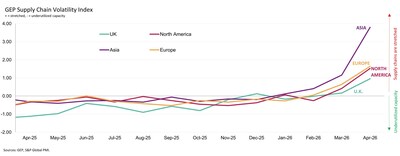
Asia reported the sharpest deterioration in supply chain conditions during April, driven by surging transportation costs, worsening shortages and rising purchasing activity. Bottlenecks also intensified significantly across Europe and North America.
Global transportation costs climbed to a record high in April, reflecting maritime disruption, soaring fuel prices and logistical challenges linked to the war in the Middle East.
"Even if tensions in the Middle East ease quickly, global supply chains are unlikely to normalize for another six to 12 months," said John Piatek, vice president, consulting, GEP. "What stands out in April's data is how broadly the disruption is spreading. Shortages worsened across every major region, signaling this is no longer an isolated transport shock. Companies worldwide are now scrambling to secure supply and protect themselves against further inflation and disruption."
Interpreting the data:
Index > 0, supply chain capacity is being stretched. The further above 0, the more stretched supply chains are.
Index < 0, supply chain capacity is being underutilized. The further below 0, the more underutilized supply chains are.
APRIL 2026 REGIONAL KEY FINDINGS
- ASIA: Index soars to 3.79, from 1.16, its highest in more than four years. Surging transportation costs were a key factor behind the index's increase, with the region more reliant on Middle East oil than other parts of the globe.
- NORTH AMERICA: Index jumps to 1.52, from 0.42, a 44-month record. Manufacturers in the U.S. and Canada purchased more materials to build inventories, leading to a sharp squeeze on supply chain capacity in the continent.
- EUROPE: Index rises to 1.64, from 0.64, a three-and-a-half-year high, as European manufacturers safety stockpiled more than any other part of the globe.
- U.K.: Index rises to 0.96, from 0.16, its highest reading since December 2022.
APRIL 2026 KEY FINDINGS
- DEMAND: Global demand for production inputs such as raw materials, commodities and intermediate goods rose in April, with purchasing its strongest in more than four years. The expansion reflected front-loaded buying activity in anticipation of price inflation and supply disruption, rather than growth due to improving underlying manufacturing conditions.
- INVENTORIES: To mitigate further price rises and supply disruption, global manufacturers built buffers into their inventories more aggressively. Reports of safety stockpiling surged higher in April and were their most widespread since January 2023 as oil prices remained volatile and uncertainty regarding the war in the Middle East continued.
- MATERIAL SHORTAGES: The items in short supply indicator rose again in April to its highest in nearly three-and-a-half years, signaling that shortages of critical materials and inputs were the highest since late 2022, towards the end of the post-pandemic supply squeeze.
- LABOR SHORTAGES: Labor shortages remained contained in April, although they were marginally above the long-run average at the global level. By region, reports of manufacturing backlogs rising due to staff shortages were their greatest in Europe.
- TRANSPORTATION: The global transportation costs tracker soared to a record high in April (data were first collected in 2005), reflecting surging fuel prices, as well as rising maritime shipping and freight rates.
For more information, visit www.gep.com/volatility.
Note: Full historical data dating back to January 2005 is available for subscription. Please contact economics@spglobal.com.
The next release of the GEP Global Supply Chain Volatility Index will be 8 a.m. ET, Jun. 10, 2026.
About the GEP Global Supply Chain Volatility Index
The GEP Global Supply Chain Volatility Index is produced by S&P Global and GEP. It is derived from S&P Global's PMI® surveys, sent to companies in over 40 countries, totaling around 27,000 companies. The headline figure is a weighted sum of six sub-indices derived from PMI data, PMI Comments Trackers and PMI Commodity Price & Supply Indicators compiled by S&P Global.
- A value above 0 indicates that supply chain capacity is being stretched and supply chain volatility is increasing. The further above 0, the greater the extent to which capacity is being stretched.
- A value below 0 indicates that supply chain capacity is being underutilized, reducing supply chain volatility. The further below 0, the greater the extent to which capacity is being underutilized.
A Supply Chain Volatility Index is also published at a regional level for Europe, Asia, North America and the U.K. For more information about the methodology, click here.
About GEP
GEP® delivers AI-powered procurement and supply chain solutions that help global enterprises become more agile and resilient, operate more efficiently and effectively, gain competitive advantage, boost profitability and increase shareholder value. Fresh thinking, innovative products, unrivaled domain expertise, smart, passionate people — this is how GEP SOFTWARE™, GEP STRATEGY™ and GEP MANAGED SERVICES™ together deliver procurement and supply chain solutions of unprecedented scale, power and effectiveness. Our customers are the world's best companies, including more than 1,000 Fortune 500 and Global 2000 industry leaders who rely on GEP to meet ambitious strategic, financial and operational goals. A leader in multiple Gartner Magic Quadrants, GEP's cloud-native software and digital business platforms consistently win awards and recognition from industry analysts, research firms and media outlets, including Gartner, Forrester, IDC, ISG, and Spend Matters. GEP is also regularly ranked a top procurement and supply chain consulting and strategy firm, and a leading managed services provider by ALM, Everest Group, NelsonHall, IDC, ISG and HFS, among others. Headquartered in Clark, New Jersey, GEP has offices and operations centers across Europe, Asia, Africa and the Americas. To learn more, visit www.gep.com.
Disclaimer
The intellectual property rights to the data provided herein are owned by or licensed to S&P Global and/or its affiliates. Any unauthorised use, including but not limited to copying, distributing, transmitting or otherwise of any data appearing is not permitted without S&P Global's prior consent. S&P Global shall not have any liability, duty or obligation for or relating to the content or information ("Data") contained herein, any errors, inaccuracies, omissions or delays in the Data, or for any actions taken in reliance thereon. In no event shall S&P Global be liable for any special, incidental, or consequential damages, arising out of the use of the Data. Purchasing Managers' Index™ and PMI® are either trade marks or registered trade marks of S&P Global Inc or licensed to S&P Global Inc and/or its affiliates.
This Content was published by S&P Global Market Intelligence and not by S&P Global Ratings, which is a separately managed division of S&P Global. Reproduction of any information, data or material, including ratings ("Content") in any form is prohibited except with the prior written permission of the relevant party. Such party, its affiliates and suppliers ("Content Providers") do not guarantee the accuracy, adequacy, completeness, timeliness or availability of any Content and are not responsible for any errors or omissions (negligent or otherwise), regardless of the cause, or for the results obtained from the use of such Content. In no event shall Content Providers be liable for any damages, costs, expenses, legal fees, or losses (including lost income or lost profit and opportunity costs) in connection with any use of the Content.
Media Contacts
Derek Creevey | Joe Hayes | S&P Global Market Intelligence |
Director, Public Relations | Principal Economist | Corporate Communications |
GEP | S&P Global Market Intelligence | Email: Press.mi@spglobal.com |
Phone: +1 646-276-4579 | Phone: +44-1344-328-099 | |
Email: derek.creevey@gep.com | Email: joe.hayes@spglobal.com |
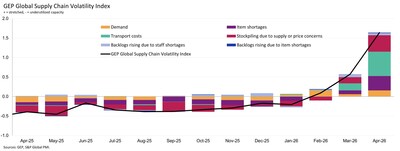

Photo - https://mma.prnewswire.com/media/2978569/GEP_SCVI_ALL.jpg
Photo - https://mma.prnewswire.com/media/2978568/GEP_SCVI_breakdown.jpg
Logo - https://mma.prnewswire.com/media/518346/GEP_Logo.jpg
 View original content: