Sungrow Presents PowerMatrix™ at Intersolar Europe 2026, Enabling Native PV-Storage Integration
MUNICH, June 25, 2026 /PRNewswire/ -- As solar PV rapidly emerges as a major power source in the global energy mix, power systems are facing increasing pressure to balance supply and demand while ensuring stability under highly dynamic operating conditions. Conventional PV-storage systems, however, were not designed to effectively manage this level of variability and complexity.
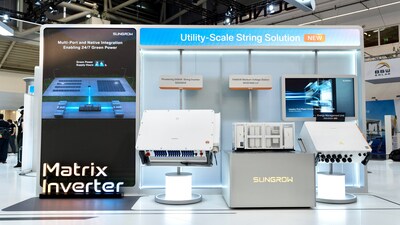
To address this challenge, Sungrow introduces PowerMatrix™ at Intersolar Europe 2026 — a next-generation energy system built on five core innovations, including multi-port topology, native PV-storage integration, distributed control, reconfigurable energy paths, and source-level grid-forming. PowerMatrix delivers source-level stability while maximizing the efficiency and economic performance of utility-scale PV projects.
System-Level Optimization for Lower LCOE
PowerMatrix moves beyond single-equipment optimization, enabling coordinated system-level optimization across the entire PV-storage architecture. Through integrated equipment design, simplified engineering, and flexible capacity configuration, it reduces BOS costs by over 10% while improving efficiency across the energy value chain from generation to consumption. Combined, these cost and efficiency gains significantly reduce LCOE.
In a reference system designed for 1 GW of rated grid connection capacity, 8 GWh of installed ESS capacity, and 3,000 annual full-load operating hours in China, the PowerMatrix reduces total CAPEX by approximately $120 million compared to a conventional AC-coupled architecture, with savings across substation & transmission cable, ESS equipment, PV equipment, and other system components.
End-to-End Efficiency Boost: +5% System Energy Yield
Traditional PV-storage systems typically optimize individual components or localized segments, leading to efficiency losses across multiple stages of the energy flow and limiting overall system performance. PowerMatrix addresses this challenge through end-to-end optimization across the full energy value chain, from generation to consumption.
- PV Side: A high-density MPPT architecture with up to 28 MPPTs per MW enables finer string-level optimization, reducing mismatch losses from shading, orientation differences, and module aging, and improving PV generation.
- Storage Side: Cell-to-plant SOC balancing increases usable storage capacity across the full lifecycle, improving total discharge energy by approximately 8%.
- Conversion and Transmission: Direct PV-to-storage charging reduces two conversion stages, improving energy transfer efficiency by 3%–5% while dynamic energy routing further reduces conversion losses.
- Renewable Energy Absorption: PowerMatrix enhances the system's ability to absorb higher PV generation, increasing renewable utilization and reducing solar curtailment.
From Compensated Stability to Inherent Stability
Unlike conventional PV-storage systems that rely on external balancing resources for stable operation, PowerMatrix embeds stability at the generation-unit level, enabling a stable power supply and enhanced grid-support capabilities.
- 24/7 renewable energy supply. PowerMatrix integrates PV, storage, multiple load types, and multiple grid connection points within a unified architecture, featuring native PV-storage integration and supporting up to 260% PV DC/AC ratio and 200% ESS capacity. Annual full-load hours reach up to 3,000, approaching the operational profile of traditional generation assets.
- Local faults are automatically isolated to ensure uninterrupted operation, enabled by redundant energy supply paths and dynamic switching of optimal power flow routes based on real-time operating conditions.
- On-demand power supply is enabled, supported by unified PV-storage dispatch and distributed control, allowing each energy zone to dynamically adapt based on demand and system conditions.
- 10 ms voltage stabilization and 5 ms inertia response are achieved by PowerMatrix's grid-forming architecture. Each generation unit functions as a grid-forming node, with each sub-array independently capable of grid-forming operation.
Leveraging these system-level advantages, PowerMatrix delivers optimized performance and adaptability across utility-scale, commercial and industrial (C&I), microgrids, and AI data center applications. It enables key capabilities for next-generation power systems, including multi-source integration, bidirectional power flow, flexible dispatch, and high system reliability.

Photo - https://mma.prnewswire.com/media/3000393/PowerMatrix_2.jpg
Logo - https://mma.prnewswire.com/media/1344575/Logo.jpg
 View original content:https://www.prnewswire.co.uk/news-releases/sungrow-presents-powermatrix-at-intersolar-europe-2026-enabling-native-pv-storage-integration-302810585.html